Monday, January 17, 2011

Cooking Foraged Mushrooms

See previous post: Mushroom Foraging at Salt Point State Park

Finally got around to cooking the mushrooms today… simply sautee with olive oil and butter, season with a little salt to keep the flavors as natural as possible. I also taste each mushroom with my lunch of orzo, homemade tomato sauce, and sauteed broccoli rabe – all the mushrooms hold their own, and the ones that are bitter don't taste so bitter anymore.

Clockwise starting at the top: hedgehog, pig ear, yellowfoot chanterelle, candy cap, black trumpet/chanterelle


Chanterelle (cut into squares),
Witch’s Butter, 2 unknowns at bottom-right
Witch's butter – expands a lot, slightly bitter, jelly taste like it looks
2 white unknowns – very bitter
(The instructor said not to eat anything unidentified, but my curiosity got the better part of me. An hour later and I still feel fine...)


Candy cap
Candy caps are my new favorite mushroom. They make the entire house smell like maple syrup and taste like it too. I have some drying right now to test its air freshener quality.

Hedgehog
Hedgehogs have high water content and taste buttery.

Black trumpet/chanterelle

Yellow foot chanterelle

Pig ear
I have to agree with the instructor, pig ears aren't very flavorful. In fact, the more I eat them, the more bitter they become.

Sunday, January 16, 2011

Mushroom Foraging @ Salt Point State Park

www.foragesf.com

Visit date: January 15

Forage seems to be THE activity these days.

Chef Rene Redzepi in Copenhagen, Denmark popularized foraging as of late to prove that his town and its surroundings is not all lost to the unstable and ever-changing weather. His restaurant Noma now holds the title of 2011 Best Restaurant in the World according to www.theworlds50best.com.

While Chef Redzepi forages in Copenhagen, I found ForageSF to show me the ropes. They offer mushroom-finding trips either in northwest Sonoma County or Oakland during peak season, usually December and January. (Season started earlier this year in November with the early rains.)

I learned a lot of cool things. Below are some of my notes during the trip…

– Salt Point is wet and damp which means more varieties of mushrooms. It's the only place open to the public with a limit of five pounds per person per day to prevent commercial collection. According to the instructor, the mushrooms are here as a gift to us. They are waiting to be picked and placed in loose-weave baskets so the tiny spores can leak through the holes of our baskets onto the ground for more growth. The rules are pictured below but the basic gist is to not make a mess for other pickers (especially Russulas, see below) and to be sensitive, watching where we step.

– Growth rate varies from overnight to a month to next season to 100 years (i.e. shelf mushrooms).

– The fruit grows out of mycelium, with different habitats resulting in different growth rates.

– Micorisal – only grow with root of host tree/plant, each helps the other grow. Mycelium is in the root.

– Treat each species as its own, some are safe but some are not. Key characteristic to look out for is texture – gills? stringy? smooth stalk? etc. Some species look so similar and are identifiable only through "spore print" process to reveal their color. Sometimes gills already reveal their color (i.e. portobello is black).

– Don't eat death caps, poisonous! They are part of the Amanita species, appear plain, grayish-white-tints of blue, looks harmless.
On the other hand, Amanita Muscaria is edible. They are red with white dots (very bright, looks like the Mario Bros. mushroom or Alice in Wonderland). The effects are psychedelic (i.e. making you feel 50 feet tall) and blurred vision, hence the "poisonous" effect. Used by Siberian shamans for medicinal purpose. To eat without side effects, boil, discard water (which has all the active ingredients), sautee.
– Little brown mushrooms are extremeley hard to distinguish, not even the experts can do it easily. Don't mess with them at all because they can be toxic.

– Don't ever eat raw. This concept is perpetuated by button mushrooms (which are mini portobellos) in salads. According to many experts, portobellos are actually carcinogenic, making them not much better as an alternative for vegetarians.

– David Arora is one of the leading mushroom experts, especially those the West coast being a California native.

– Paul Stamets – micoremediation – repair soil by growing mushroom because of underground mycelium acting as a sort of "underground internet" delivering needed nutrients
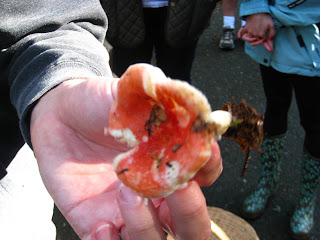
Russula

very old, rotting Russula
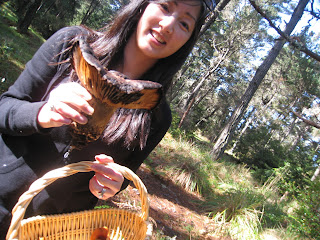
Russulas are the most common and mostly inedible. They won’t kill a person, but will cause bad side effects. Some are edible like the Candy cap (see my basket below). Overall, no one really knows how to cook them to be edible.
Common characteristics: white (some red), white gills and spores, naked, no scales, no rings, bleeds milk, stalk will snap like chalk when broken (more bendable when older). The test is to throw Russulas against trees/rock/ground and the mushrooms will shatter.
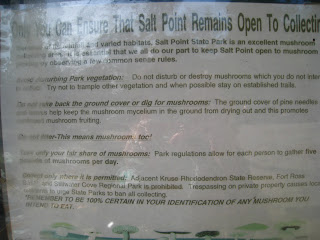
rules


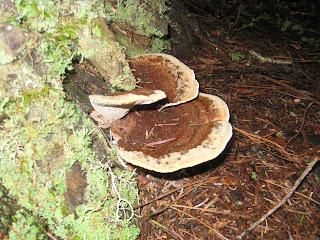
Shelf mushrooms
Shelf mushrooms – are micorisal, grows on tree; no gills, instead have pores; very firm in touch. Mycelium is inside the tree. Have some medicinal purpose. This particular one is about 2 seasons growth in size.
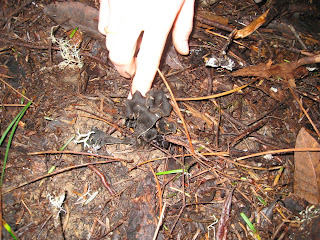
Black trumpet/chanterelles
Chanterelles can be rot free for months (maybe anti-microbial too when eating), like to grow around tan oak trees.

Pig ear

Pig ear

Pig ear

Pig ear
Pig ears are edible but typically not eaten because they don't have much flavor. They are the easiest to spot because of their size.
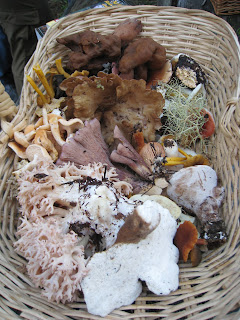
This is the instructor’s basket –
many are inedible, but will be used
to teach his students tomorrow

my basket 
My basket clockwise starting at top left corner:
Pig ear (edible), Candy cap (orange, edible), Black trumpet/chanterelle (edible), regular Chanterelle (edible, one of two found today), unknown round porous mushroom, white quarter size (too young to tell), Witches butter (orange, jelly texture, edible), Yellow foot chanterelle (edible), Coral (white stringy looking, inedible), Hedgehog (light brown in the middle, edible).

Candy caps are edible russulas. They smell like maple syrup or butterscotch, bleed white, and have a hollow stalk. The instructor suggested I dry them in my car to be used as natural air freshener.

Black chanterelles are the hardest to see, of course, because of their color. But once we find one and know what we are looking for, they are pretty easy see.

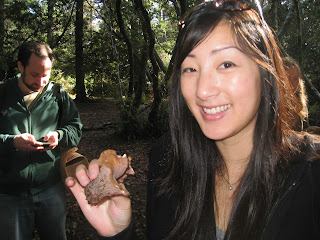
Also, there was one couple that found the only Matsutake of the day, a bit old but still edible. The size was probably as big as the old rotting Russula I found.

We all take our finds home at the end of the day. Next step is to cook them and see how they taste. Too bad I forgot to bring the travel burner and pan to cook them on the spot.

See additional post: Cooking Foraged Mushrooms
first hour of our two-hour drive back


Friday, January 14, 2011

Caffe Pascucci

Visit date: January 14

Caffe Pascucci is a staple in Europe, and now has its first US location open across the street from AT&T Park. It is a coffee shop but nothing like the artisanal coffee shops we’re used to seeing in San Francisco, i.e. Blue Bottle, Ritual, Intelligentsia, etc. The café is brightly lit and the décor is uber modern with brown tables and white seats. Some of the chairs are half round, reminding me of something found in the Jetsons. There are three seating areas, one to either side of the barista counter, and bar-style seating directly across from the counter. The walls are padded with the same white material from the chairs, maybe to help with the acoustics or just for decoration alone.

Drink descriptions read like desserts and the pictures show an elegance created by a pastry chef. I’ve only had the sorbetto amaretto (ice blended coffee with amaretto syrup topped with amaretto biscuits), but seeing the throngs of people receiving their free drinks, Caffe Pascucci is definitely offering more coffee dessert drinks than actual coffee. This place will satisfy cravings of coffee and sugar all in one. French press and drip coffee available too.

I’m assuming Caffe Pascucci is to Europe what Starbucks is to the US, but with a bigger menu offering sandwiches, salads, charcuterie, cheese and the usual pastries. They’ve trademarked things like Confuso cream (not sure what this is) and Fraspuccio (aka Starbucks Frappucino). There’s free WiFi too!

For this first opening week, the first drink is free – anything on the menu.

my sorbetto amaretto and a sampling of chocolate pie


Mission Pie vs Tartine Bakery

www.missionpie.com
www.tartinebakery.com

MP Visit date: January 13, December 21
TB Visit date: few months ago

Dessert anyone?
(Only in moderation of course.)

The closest thing to pie that I’ve had in the last few years is apple cobbler when it’s on restaurant dessert menus. (The best cobbler is at Frascati.) Prior to that, I grew up eating Marie Callender pies for special occasions.

So I was really excited when I heard about Mission Pie, especially with banana cream on the menu. It’s my new go-to dessert without being at a restaurant. The texture is light, fluffy and gooey. The bananas are ripe yet firm, not oxidized brown, and slightly enhanced with sugar but not overly sweet. The crust on the bottom is croissant-thin and flaky, while the crust on the side is thicker, also flaky.

On the other hand, Tartine uses a coating of hardened caramel between their filling and crust. I’m not a caramel fan (unless it's flan) – don’t like the flavor of burnt sugar and water. I have a hard time getting over the caramel so I can’t enjoy the crust. The filling is decent, but I can’t complete the full experience without the crust.

Along the lines of burnt tastes, Tartine’s croissants and cookies are a little over baked for my liking. I like my croissants to have a couple light layers of crust, but Tartine seems to like theirs with lots of crunchy, crusty layers. These layers also make the croissants pretty dark brown in color, which if we eat with our eyes, is already not appealing to me.

Tartine is a fancy show bakery offering a suite of products for out-of-towners. The line is always wrapped around the corner and the inside crowded, just so people can get a glimpse of a bakery that’s produced a cookbook and been in the media.

Mission pie is humble and simple and good and comforting. Their small list of pies are listed daily on the steel support beam by the display case. Here’s a blurb from their website:
“Through creative choices in all aspects of the business, from our energy-efficient kitchen to our delicious Fair Trade/organic tea and coffee to the reclaimed and recycled materials with which the café is constructed, Mission Pie is guided by a commitment to environmental, social and economic justice. We offer a wholesome and supportive atmosphere not only for lovers of great coffee and pie, but for our workers as well, as we collaborate with local youth advocacy organizations to provide a positive work environment to San Francisco youth. As a thriving, progressive, for-profit business, we relish the opportunity to reinvest productively and creatively not just in the quality of our ingredients and equipment, but in the lives of the people and communities around and within us.”

(All pictures below are from Mission Pie.)

menu written on
steel support beam

banana cream

sweet potato


menu written on steel support beam,
coffee/tea on blackboard