Thursday, February 3, 2011

Dinner @ Home - Rice Cakes

Dinner: February 01

Rice cakes make my top 10 favorite things to eat. It's pretty much always in the shopping cart when I go grocery shopping at 99 Ranch. I usually mix it with sauteed ground pork and a vegetable of some kind (i.e. Chinese mustard greens, Chinese celery, Napa cabbage). Making this dish requires some multi-tasking.

1. Marinate one pound of a fattier ground pork with soy sauce, sesame oil, shao xing rice wine (I hear sherry wine is a good substitute), pepper – 30 minutes to overnight in the fridge. Feel free to add other spices like cumin, coriander, Chinese five spice, curry, etc.

2. Chop vegetable of choice into bite size pieces and thoroughly rinse. The portion should be enough so each bite has equal parts ground pork and veg. (Sometimes it's easier to rinse after the veggies have been chopped, only wash what you need.)
In this case, I use only the stalks of Chinese celery cut into 1-inch pieces. Chinese celery is thinner and has a smell almost like cilantro. 99 Ranch bags the celery (about 1.5 pounds) and is just enough (minus the leaves) with the pound of ground pork.

When using Chinese mustard greens, chiffonade the greens. Next, give a rough chop but leave some quarter-inch chunks of the stalk for added crunch. Place the chopped greens into a tupperware and mix with finely chopped fresh ginger and a generous portion of salt (2-3 heaping tablespoons) to draw out the water from the greens – 5 hours to overnight in the fridge. Again, 99 Ranch bags the mustard greens, but can be too much if chopped too finely. If this is the case, I prefer to use more pieces from the stalk because I like the crunch. Also, one bag of greens roughly equates to finely chopping a 3-inch piece of fresh ginger. When ready to use, squeeze out the excess water. The mixture may need to be rinsed depending on salt content.
2. Rice cakes usually come in a vacuum sealed bag (about 2 pounds), and is hard and clumped together. After opening the bag, pull rice cakes apart so they are no longer sticking to each other. Set aside.

3. Fill a pot with salted water and let boil. Turn off the heat when water is at a boil. Set aside.

4. Using a fry pan or medium-sized pot (I use my Le Creuset dutch oven), sautee the ground pork until it is no longer pink, about 10 minutes. Add bite-size vegetable and continue to sautee until cooked through, about 5 minutes. Turn off the heat.

5. Using the pot of hot, salty water, blanch rice cakes in batches (handful portions) for about 20 seconds to soften. It's best to use a deep noodle strainer for quick and easy removal. Keeping the rice cakes in hot water makes them gooey and mushy.

6. Combine the blanched rice cakes into the hot pan containing the sauteed ground pork and veggies. The heat from the sautee will continue to soften the rice cakes which also absorbs the pan juices. The idea is for each bite to have all the components of rice cake, ground pork and crunchy veg.

This recipe makes about 5 portions, but it all depends on who's eating.

Bon appetite!

finished product


Chinese celery

Chinese celery cut into 1" pieces (stalks only)

Chinese mustard green

ground pork being sauteed

rice cakes - out of the package and separated,
not yet blanched so still in hard form

rice cakes about to be blanched

deep noodle strainer

Wednesday, February 2, 2011

TCHO Chocolates

www.tcho.com

Visit date: February 01

Chocolate has come a long way from the days of Montezuma and the Aztecs. In addition to the spices they used, we now have sugar and other sweeteners for an even tastier drink. We’ve learned to temper chocolate so we can form it into candy bars ranging from dark (my favorite) to milk to white (is it really chocolate?) chocolate. Pastry chefs are using chocolate to create extravagant show pieces and chefs are using chocolate in their cooking.

TCHO is a small chocolatier in San Francisco that is taking chocolate one step further. (Nowadays, very few chocolatiers make their own chocolates, but instead, buy pre-made chocolate.) Rather than making chocolates strictly by a percentage measuring cocoa butter and solids and labeling it as such, as many fancy chocolatiers do, TCHO creates their chocolates based on flavors. Flavors reveal much more about the chocolates than a percentage – common sense as they call it. While all their chocolates contain between 65-70% chocolate, one bar containing 67% percent and another bar containing the same percentage can differ greatly in taste depending on origin and the environment the beans are grown in.

To this end, TCHO created a flavor wheel of 6 flavors. Currently 4 flavors are being made:
“Chocolatey” comes from West Africa where majority of beans are grown
“Citrus” comes from Madagascar
“Fruity” comes from Peru
“Nutty” comes from Ecuador

Quotation marks are used because these adjectives describe only a part of the taste. There are many more nuances to the chocolates, similar to wine. See their flavor wheel for more detailed taste descriptions. I also ask about “earthy” and “floral” which they are working on, but just haven’t found the right beans they’d like to use.

Another unique aspect of TCHO is their techy background. A few key people are veterans from the Silicon Valley tech world. Namely, co-founder Timothy Childs, has on his resume, developed machine vision systems for NASA. In keeping with this vibe, TCHO has refurbished used chocolate equipment and outfitted them with the latest technology. They worked with a Silicon Valley company to create an iPhone app that allows for control of all steps of the chocolate making process from anywhere in the world. Weather stations are also installed in each country to quickly understand climate conditions and make adjustments as necessary. From the marketing aspect, the techy-ness is maintained in their packaging by using “algorithmic guilloche patterns to look like a modern form of currency” similar to how the Aztecs used cocao beans as currency to barter.

Lastly, TCHO goes beyond fair trade. To get the best quality bean, they work very closely with the farmers and co-ops. Education is key as TCHO developed new fermenting and drying processes to optimize each bean and keep consistency. Processing the beans into nibs is done in each country to help the local economy. Each country also has their own flavor lab to create the finished product so workers understand what it is they’re doing. More often than not, workers have no idea what the finished product looks or tastes like. Education and communication is key. TCHO is also very proud to recognize that a partner co-op named Oro Verde in Peru won Peru’s 2008 National Cocoa Competition!

Free tours are offered everyday at 10:30am and 2pm. Walk-ins are welcome although reservations are recommended, especially on weekends. Due to the noise level on the production line, our guide covers all relevant points via slideshow and virtual tour first. Walking through the line takes about ten minutes since the factory is small. We are asked to wear hair nets and beard nets. For sanitation reasons, no jewelry, cell phones, and cameras are allowed. But still, I managed to sneak in some pictures.

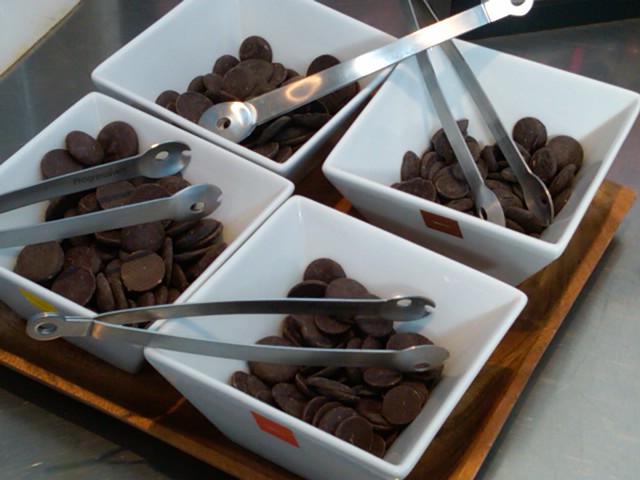
Of course, all this information and more is laid out on their website, but the tour is nice for the lazy people who don’t care to read. My main reason for coming is to try their hot chocolate. I was at Christopher Elbow chocolates a few months ago and a fellow hot chocolate drinker recommended TCHO which offers the traditional, plain hot chocolate. Delicious! Tastes just like their "chocolatey" bar. (Elbow offers hot chocolate with about ten different flavor combinations using spices and fruits.)


The length of the factory is partitioned into three sections: retail shop, video/slideshow area, and production line. This picture is the actual production line divided in two by plastic sheets – first is the de-molding and packaging half while the back is where all the magical mixing, conching and molding happens.


chocolate making half of the production line

chocolate making half of the production line

Chocolate bars have been de-molded. Empty molds come back down the conveyor belt to be filled with more chocolate.

Empty molds go through to be filled with chocolate, then cooled halfway down where the machinery starts to look different. This machine sits between the two parts of the production line separated by plastic sheets. There is a noticeable temperature difference between the creating half and the cooling, de-molding and packaging half.

de-molding


cocoa bean pod, about 10" long


Frascati

www.frascatisf.com

Visit date: January 31, usually once every other month

Frascati is the quintessential neighborhood hangout – solid rustic Italian food, great atmosphere, friendly owner/staff who know me by name. It’s no wonder I hop in there at least once every other month. Sometimes it’s for a full meal, and sometimes just a glass of wine or dessert. When the weather’s nice, they setup tables outside and I enjoy the sun with a glass of Prosecco. Cable cars filled with tourists pass by with an envious look. Life really doesn’t get better in San Francisco.

For dessert, Frascati has a killer apple cobbler with lots of crumble topping and served hot with a heaping scoop (probably the size of 2 regular scoops) of vanilla ice cream. To the very end, each bite has apple, topping and ice cream. I never run out of one before the other. I recommend sharing the apple cobbler because it’s big, probably 4” in diameter. But if I want something lighter (still plenty to share), the affogato is perfect – vanilla ice cream with espresso poured over top and a chocolate chip biscotti (which I have tonight).

Some other really tasty dishes, but not pictured below include:
- Monterey bay sardines with meyer lemon aioli, chili oil, micro greens and grilled ciabatta
- Duck confit salad with baby spinach, red onions, dried cherries, gorgonzola cheese and balsamic reduction
- Maple leaf duck breast with herb spaetzle, hearts of palm salad, wild arugula, scallions and huckleberry sauce
- Roasted half chicken with baby artichokes, cipollini onions, herb bread crumbs baby spinach, fingerling potatoes and lemon-oregano jus
- Grilled pork chop with potato puree, bacon braised romano beans, tomato-olive compote and cipollini jus
- Fresh pappardelle with wild boar sugo, roasted tomato, baby spinach and pecorino romano


russet potato gnocchi with melted shallots,
butternut squash, black 
trumpet mushrooms,
parmesan and white truffle oil
One of my favorite gnocchi's in town. It's a little denser with a nice sear to give it some more texture. The accompaniments differ as seasons change and it's always good. It's like craving pasta but without the pasta. Of all the menu items, the gnocchi really is my go to dish.

octopus salad with potato confit, wild arugula,
black olives, blood 
orange and chorizo vinaigrette
Perfect combination of salty and sweet. The octopus is cut into thick chunks, not overcooked nor rubbery.

roasted rabbit risotto with roasted shallots, prosciutto,
carrot 
puree, baby spinach and parmesan

brussel sprouts with capers and brown butter

affogato - vanilla ice cream with espresso and biscotti


Commonwealth by Chef Jason Fox

www.commonwealthsf.com

Visit date: January 29

Everyone should come to Commonwealth for their charitable business model alone. For every $60 tasting menu ordered, the restaurant gives $10 to a new non-profit organization every two weeks. This isn't a gimmick to get diners in the door to then eat bad food. The vision at Commonwealth is charity, 3 star service, and 3 star food with 2 star prices (each dish is between $5 and $16). The latter take on service, food and prices has been a popular spin on fine dining in light of the economy the last few years.

The restaurant is a decent size, very minimal, and divided in two – dining room in front and kitchen in back with bar seats available. The servers are very knowledgeable about the food, but also promptly come back with the answer if they don't know. The only complaint is that we sit in the corner by the kitchen and it is very hard to hear. The waitress' voice just gets swallowed by the walls or something.

Every dish is flavorful and pretty to look at, lots of colors and textures happening. The one dish that stands out is my beef tongue with slow cooked farm egg, savoy cabbage, rutabaga, and fresh wasabi. Being Chinese, I grew up eating exotics cuts of meat and I love runny eggs. When eating beef tongue, keep in mind the texture is supposed to be a bit chewy. Chef Fox seared the outside and braised it in some fat and juices. I imagine he handled the tongue very minimally so as to not overwork the meat which then becomes tough and rubbery. But also recently, I've been braising a lot of cabbage at home with different sauces to complement its sweet flavor. So to see Chef Fox's take using ingredients I really enjoy is inspiring.

One dish that is good but with a weird component is the winter root vegetables in various forms, with chickweed, puffed amaranth and vegetable ash. Can you guess which part is new to me? It's the vegetable ash coating the salsify, camouflaging the vegetable entirely since the serving dish is a piece of black slate. I try the salsify and it's edible but certainly not my favorite because the ash is too bitter for my liking. It also tastes like I just ate dust from the duster; maybe not that bad, but it's the only thing I can think of. Other than being different, the ash, maybe, is not even necessary. If I recall correctly, the ash is made from charred vegetables, but beyond that, I can't really hear the waitress.

Overall, Commonwealth is worth another visit when the menu changes.

asian pear, chicories, pomegranate,
cured ham, idiazabal cheese, long pepper

grilled chicken livers, brown rice-black pepper cracker, saba

chickpea panisse, romesco sauce

pumpkin, black kale, yuba, sprouting broccoli,
coconut milk, peanut

winter root vegetables in various forms,
chickweed, puffed amaranth, vegetable ash

sea urchin, sweet potato tempura, chrysanthemum
leaf, shiso, scallion, yuzu kosho

beef tongue, slow cooked arm egg,
savoy cabbage, rutabaga, fresh wasabi

beef tongue, slow cooked arm egg,
savoy cabbage, rutabaga, fresh wasabi

dayboat scallops, Jersualem artichoke,
brussel sprouts, leek, ginger, tonka bean

dayboat scallops, Jersualem artichoke,
brussel sprouts, leek, ginger, tonka bean

cedar grilled pork shoulder, nettles, tepary beans,
fuji apple, miso, bacon vinaigrette

cedar grilled pork shoulder, nettles, tepary beans,
fuji apple, miso, bacon vinaigrette

frozen coconut mousse, citrus salad,
rau ram, sesame tuile

lemon sponge cake, thyme ice cream,
candied honey, crème fraiche

peanut butter semifreddo, chocolate ganache,
frozen popcorn, caramel


Tuesday, February 1, 2011

Science of Taste: Savor Your Soil (organic vs conventional)

www.18reasons.org

Visit date: January 27

The night starts out with a blind taste test of a variety of veggies (carrot, celery, lettuce, kale, orange, and wine thrown in for fun) grown conventionally and organically by small farms (rather than commercial organic). We gather around the big wooden table to discuss – organically grown veggies are, for the most part, deeper in color and the flavors more enhanced. Presented side by side like this, it's easy to say "buy and eat organic".

Through ninth grade biology, revisited tonight, we learn about the layers of the earth: top soil (rich in humus/minerals), sub soil (rich in minerals), rocks/fragments (little life), bedrock (no life). Organic farmers strive for the purist form of top soil which contains all the nutrients to create yummy veggies. (It is estimated that 1 inch of topsoil takes 100-500 years to grow!) Unaltered top soil is dark, almost black. The better the top soil, the more effective the nitrogen cycle for plant growth. Better top soil also means more effective photosynthesis to produce sugars which are then exchanged with other organisms in the soil. From an environmental perspective, good soil prevents run-off and erosion during rainy season. The soil retains nutrients so the water moves through the soil rather than taking dirt with it, creating muddy water.

When the "cides" (pesticides, herbicides, fungicides) are introduced in traditional farming, top soil is harmed. It starts with fertilizers to speed growth, sucking more than the necessary amount of nutrients out of the soil. Pests, which are attracted to abnormal things, invade the veggies because of their abnormal size. Now pesticides enter the equation to rid the pests. Weeds, an indicator or what's in the soil, start to grow to repair the damage caused by the overgrown veggies. Rather than respecting the weeds and what it has to tell farmers, farmers buy herbicide. And of course fungus starts to grow, introducing the need for fungicide. The cycle continues. And it can be said rather than making money off their land, they spend more money on these "cides", needing to farm more to make up for lost revenue, and again, the cycle continues.

So the story here, organic is the better way to go – more nutrients, better for the environment, less "cides". But why don't more Americans eat organic? Because in some twisted fate, the government has subsidized farming so much that crops sell for less than what it takes to produce them. This causes farmers to grow more, which inflates the market and drives prices down even further. So at the supermarket, conventionally grown veggies are cheaper than organic. Most Americans have a small sense of the benefits of organic, but unless they sit in a room like us and sample veggies side by side, their budgets just can't afford these high prices. Or, maybe they can, but the conventionally grown veggies taste just fine. (I'm guilty of this.)

On the other hand, we have "food deserts", areas where residents don't have access to fresh, affordable food. Subsistence is mainly off of fast foods and convenience foods, many of which are chemically created using some form of corn to provide calorie-dense foods. So here's to President Obama's Healthy Food Financing Intiative to reduce food deserts.

Check out the Food Environment Atlas for some more stats.